

About Me
I am a resident of the Central Valley, and have been teaching at De Anza College since 2020. I teach courses in Western Civilization, World History, and United States history. I am committed to my students' success. I am available to help and answer student questions.
History 7B: Modern Latin America History Fall Quarter 2026
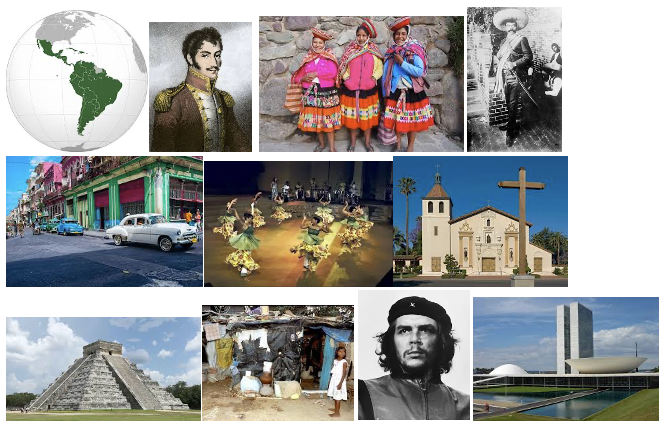
History 7B: Modern Latin American History (CRN: 29012) is an ONLINE asynchronous class for Fall 2026 quarter. Students will have the opportunity to complete assignments online, on their own time.
History 7B fulfills the following GE areas:
- De Anza: Area 4
- Cal-GETC - (UC/CSU): Area 4
Did you know that Mexico and Brazil, before becoming republics, were established as kingdoms post-independence? This and many other aspects will be topics of our discussion in History 7B: Modern Latin America, as we will examine this dymamic region's history of triumphs and struggles with democracy, identity, and economic independence. We will focus on the time period from post-colonialism to the present (1810 to the present). We will start by examining the political state of Latin America post-independence as the region attempted to establish an identity for itslef. We will examine the struggle between those advocating geographically vast political alliances, irrespective of their cultural complexities, to regional nationalists who favored more geographically and culturally homogeneous states.
We will discuss the struggle between economic elites and the poor masses; the struggle between the region and their more powerful northern neighbor, the United States. As we move into discussing the twentieth century, we will examine the dilemmas facing the region during the Great Depression, World War II, and the Cold War. Why, we will attempt to understand, did a region that was steeped in a tradition of republicanism so easily turn to military dictatorships in the Twentieth Century?
Interesting historical documents will give you first-hand accounts of different people's views of their region. We will learn about the struggles and aspirations of political, economic, and cultural institutions. I am always happy to meet with students during my Zoom office hours.
If you have any questions about the class, please email me at: edgargeorge@fhda.edu
Courses I Have Also Taught in the Past:
History 3C: World History from 1750 C.E. to Present
History 3C
- CRN: 27746
- Format: Online – Asynchronous
History 3C fulfills GE areas for
- De Anza GE (Area C2 or D)
- CSU GE (Area C2 or D)
- UC/IGETC (Area 3B or 4)
This is an asynchronous class, which means it is strictly an online class with no meetings. All work is downloaded to Canvas on a weekly basis, allowing you plenty of time to work at your own pace.
In History 3C, we will discuss the foundations of the modern world. Let us look at some of the topics. Capitalism and free trade, which dominate the contemporary global economy, took off in the seventeenth century as a result of European expansion.
Today, we hear about globalization, the movement of goods and people across the globe. This phase, too, has its origins in the timespan covered in History 3C. European imperialism, which saw the movement of goods and people globally, fueled the globalization of commerce.
We will discuss the onset of modern industrial economy and the dilemmas it entailed for largely traditional agricultural societies. We will examine the problems and disagreements that arose between workers and their new employes, as the former were forced to acclimate to new workplace rules that restricted their independence. This will lead us to discuss the rise of radical ideologies, like communism, that argued the basis of the industrial economy hinged on the exploitation of workers by their bosses.
Industrialism, in addition, led to a scramble for natural resources among the industrializing nations, namely Western Europeans and Americans, across the globe. This, in turn, led to fierce competition and rivalry, which ultimately led to outbreak of World Wars I and II.
We will discuss the brewing rivalry between communist countries and those committed to free market economies after World War II, an episode known as the Cold War.
Lastly, we will conclude with the acceleration of globalization that has seen integration of cultures and economies across continents. So, we will discuss the dilemmas this trend has caused. We will discuss the rise of nationalism, xenophobia, and intolerance, which were thought to be relics of a dark past.
In addition, we will read interesting historical documents that give you first-hand accounts of the major events in our course of study. I am always happy to meet with students during my office hours. If you cannot make it to my office, then we can hold Zoom meetings. If you have any questions about the class, please email me at edgargeorge@deanza.edu.
History 6C: History of Western Civilization From 1750 C.E. to Present
History 6C
- CRN: 27748
- Format: Online – Asynchronous
History 6C fulfills GE areas for
- De Anza GE (Area C2 or D)
- CSU GE (Area C2 or D)
- UC/IGETC (Area 3B or 4)
This is an asynchronous class, which means it is strictly an online class with no meetings. All work is downloaded to Canvas on a weekly basis, allowing you plenty of time to work at your own pace.
In History 6C, we will discuss the foundations of the modern world. Let us look at some of the topics. Capitalism and free trade, which dominate the contemporary global economy, took off in the seventeenth century as a result of European expansion.
Today, we hear about globalization, the movement of goods and people across the globe. This phase, too, has its origins in the timespan covered in History 6C. European imperialism, which saw the movement of goods and people globally, fueled the globalization of commerce.
We will discuss the onset of modern industrial economy and the dilemmas it entailed for largely traditional agricultural societies. We will examine the problems and disagreements that arose between workers and their new employes, as the former were forced to acclimate to new workplace rules that restricted their independence. This will lead us to discuss the rise of radical ideologies, like communism, that argued the basis of the industrial economy hinged on the exploitation of workers by their bosses.
Industrialism, in addition, led to a scramble for natural resources among the industrializing nations, namely Western Europeans and Americans, across the globe. This, in turn, led to fierce competition and rivalry, which ultimately led to outbreak of World Wars I and II.
We will discuss the brewing rivalry between communist countries and those committed to free market economies after World War II, an episode known as the Cold War.
Lastly, we will conclude with the acceleration of globalization that has seen integration of cultures and economies across continents. So, we will discuss the dilemmas this trend has caused. We will discuss the rise of nationalism, xenophobia, and intolerance, which were thought to be relics of a dark past.
In addition, we will read interesting historical documents that give you first-hand accounts of the major events in our course of study. I am always happy to meet with students during my office hours. If you cannot make it to my office, then we can hold Zoom meetings. If you have any questions about the class, please email me at edgargeorge@deanza.edu.
History 17B: History of the United States From 1800–1900
History 17B
- CRN: 27750
- Format: Asynchronous Online
History 17B fulfills GE areas for
- De Anza GE (Area C2 or D)
- CSU GE (Area C2 or D)
- UC/IGETC (Area 3B or 4)
This is a fully Asynchronus, online class. There are no meetings. All work is downloaded to CANVAS on a weekly basis, allowing you pleanty of time to work at your own pace.
This class can be double-counted for both GE and the US history graduation requirement at the CSU and UC. In addition, the in-person classroom experience will give you an opportunity to meet new people and engage with them, and will help you become familiar with what it is like to be in a university classroom, since four-year universities overwhelmingly meet in-person.
Some of the questions we will explore include, how did the United States come to have multiple political partis? Why does a country that celebrates diversity continue to struggle with racism? How did the United States come to control the territories between the Atlantic and the Pacific oceans. These are just a few questions that will be the subject of our discussion in History 17B.
We will begin the course by discussing the political disagreements between the Founders that led to the formation of political parties. We will compare and contrast the vision of both Federalists and Democrat-Republicans for the young republic. Eventually, we will transition to the establishment of the modern Democratic and Republican parties, which have their origins in the nineteenth century as well.
We will discuss “Manifest Destiny,” a term given to U.S. territorial expansion across western North America, and the war that it entailed with Mexico.
In 17B, we will discuss the Civil War and the events leading up to its outbreak. We will discuss why the slave-owning states lost the war, and will go over the aftermath of the war, the Reconstruction, and discuss why it failed.
We will conclude the course by discussing the emergence of the United States as a global industrial and military power by the end of the nineteenth century, and the dilemmas such influence posed for the country.
Interesting historical documents will give you first-hand accounts of different people’s views of America. I am always happy to meet with students during my office hours. If you can’t make it to my office, then we can hold Zoom meetings. If you have any questions about the class, please email me at edgargeorge@deanza.edu
Classes I Teach
Winter 2027
| CRN | Course | Sec. | Title |
|---|---|---|---|
| 35669 | HIST 17A | 02Z | History of the United States to Early National Era |
| 35670 | HIST 17C | 53Z | History of the United States from 1900 to the Present |
Fall 2026
| CRN | Course | Sec. | Title |
|---|---|---|---|
| 25284 | HIST 3A | 01Z | World History from Prehistory to 750 CE |
| 25866 | HIST 3A | 51Z | World History from Prehistory to 750 CE |
| 29049 | HIST 3AH | 01Z | World History from Prehistory to 750 CE - HONORS |
| 29051 | HIST 3AH | 51Z | World History from Prehistory to 750 CE - HONORS |
| 29012 | HIST 7B | 50Z | Modern Latin American History |